"Serbian Naval Commander" - Ilija Gojković - The General Who Never Surrendered

Ilija Gojković (Drenovac, August 2, 1854 – Ionian Sea, February 15, 1917) was a Serbian general and Minister of War of the Kingdom of Serbia. Rising from the ranks of an ordinary soldier, he became one of the few Serbian generals to build his entire military career without graduating from a military academy. 

Ilija Gojković (third from right) with diplomats and Branislav Nushic (seccond from right) at the train station in Bitola 1912/13
Ilija Gojković (third from right) with diplomats and Branislav Nushic (second from right) at the train station in Bitola 1912/13 (Photo: State Archives of Macedonia, Bitola Department (Manaki Fund))


Remembered for his extraordinary courage and leadership, Gojković was also the only general of the Serbian Army to die in direct combat — killed in 1917 after defiantly opening fire with a handgun on a German submarine that demanded his surrender in the Ionian Sea.

Born on August 2, 1854, in the village of Drenovac near Paraćin, Gojković completed the Kruševac Gymnasium in 1870. At just sixteen years old, he joined the Army of the Principality of Serbia as a volunteer. After six years of service as a non-commissioned officer and military clerk, he was promoted to Second Lieutenant of Infantry despite never attending the Military Academy.

Participation in the Serbian–Turkish Wars

Gojković distinguished himself during the Serbian–Turkish Wars. In 1876, he fought at Veliki Izvor as commander of the Homolje Battalion of the National Army. For his bravery, he received the Silver Medal for Courage and the Russian Order of Saint Stanislaus with Swords, Third Class.

During the campaigns of 1877 and 1878, he participated in the battles of Gramada and the liberation of Niš, earning the Gold Medal for Courage. After the war, in 1879, he took part in suppressing the Albanian uprising in the Toplica region.

Rise Through the Serbian Army Ranks

In the Serbian–Bulgarian War of 1885, Gojković commanded the 4th Battalion of the 4th Infantry Regiment during the Battle of Slivnitsa. His military career continued to advance steadily: he became a Major in 1889 and a Lieutenant Colonel in 1896, when he was also awarded the Takovo Cross, Fourth Class.

He was promoted to Colonel in 1899 and given command of the Danube Infantry Brigade within the Drina Divisional Area, while also serving as Head of the Economic Department of the Ministry of War.

Political Challenges and Role as Minister of War

In November 1901, Gojković fell out of favor with King Alexander Obrenović and was forced into early retirement. However, he participated in the May Coup of 1903, after which he was reinstated and returned to his former position in the Ministry of War.

From March 4, 1909, to March 1910, he served as Serbia’s Minister of War. He resigned after the government rejected his proposal to modernize the mountain artillery. During his tenure, he received several prestigious decorations, including the Order of the White Eagle, Fourth Class, the Order of Saint Sava, Second Class, and the Russian Order of Saint Stanislaus, First Class.

Balkan Wars and World War I

In 1911, Gojković was appointed commander of the Morava Divisional Area and the First Call Morava Division. He led the division during the Balkan Wars and distinguished himself at the Battle of Kumanovo, where he was promoted to General and awarded the Karađorđe’s Star with Swords, Fourth Class.


Ilija Gojković (sitting in the middle) with diplomats and Branislav Nushic (sitting left) in Bitola 1912/13 (Photo: State Archives of Macedonia, Bitola Department - Manaki Fund)
Ilija Gojković (sitting in the middle) with diplomats and Branislav Nushic (standing in the middle) in Bitola 1912/13 (Photo: State Archives of Macedonia, Bitola Department - Manaki Fund)


He continued commanding the Morava Division during World War I, particularly in the Battles of Cer and Kolubara. Gojković became renowned for his courage and personal leadership, often encouraging soldiers from the front lines. His troops affectionately called him “our old uncle” (“naš Čiča”).

Later, he briefly commanded the Užice Army and then the Timok Army, which successfully defended Serbia’s borders against attacks by the Bulgarian First Army. His forces distinguished themselves in the fighting near Kačanik before retreating through Albania to Corfu during the Serbian army’s great withdrawal. During this retreat, Gojković contracted typhus in Durrës and was sent to France for treatment.

Death in the Ionian Sea

While returning from France to the Macedonian Front, near Sicily on February 15, 1917, the ship Mimas, carrying General Gojković, was torpedoed by the German submarine U-39 under the command of Walter Forstmann.

After boarding a lifeboat, the German submarine surfaced and demanded the surrender of the officers in the boat. Gojković refused with the words:

“A Serbian general never surrenders!”

He then opened fire on the submarine with his pistol. The submarine’s machine gun immediately cut him down, and the lifeboat sank into the Ionian Sea.

Legacy of Ilija Gojković

Ilija Gojković is remembered as one of Serbia’s bravest military leaders — a self-made officer who rose from the ranks of an ordinary soldier to the rank of general through courage, discipline, and battlefield leadership. His refusal to surrender in the final moments of his life became one of the enduring symbols of Serbian military honor and resistance.


Balkan Wars 1912-13 - Photo Gallery - Part 3

The Balkan wars took place in Southeast Europe in 1912 and 1913. The First Balkan War began on October 8, 1912, when Bulgaria, Greece, Montenegro and Serbia formed a Balkan alliance against the Ottoman Empire. The war ended with the signing of a peace treaty in London.
The Second Balkan War broke out on June 16, 1913 when Bulgaria, dissatisfied with its gains, attacked its former allies, Serbia and Greece. The war ended with the signing of a peace treaty in Bucharest.

The postcards shown in this post are from different sources and are not arranged in a specific order.

Serbian postcard - "Bloody battle at Bitola" - First Balkan War Battle of Bitola (Battle of Monastir) - 16 to 19 November 1912
Serbian postcard - "Bloody battle at Bitola" - First Balkan War
Battle of Bitola (Battle of Monastir) - 16 to 19 November 1912

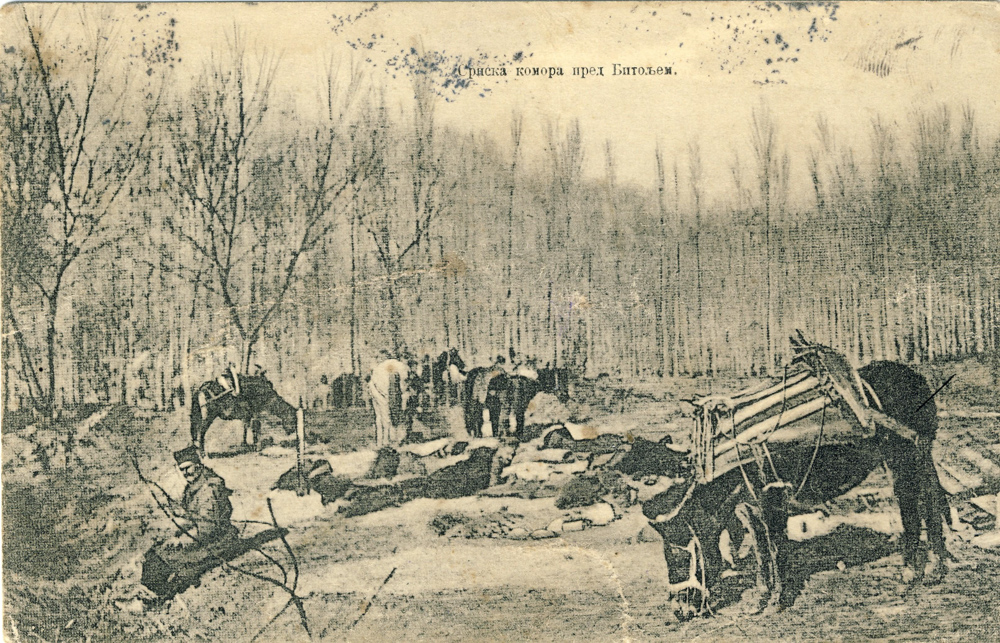
Serbian army unit near Bitola - First Balkan War Battle of Bitola (Battle of Monastir) - 16 to 19 November 1912
Serbian army unit near Bitola - First Balkan War
Battle of Bitola (Battle of Monastir) - 16 to 19 November 1912

Serbian army near Bitola - First Balkan War Battle of Bitola (Battle of Monastir) - 16 to 19 November 1912
Serbian army near Bitola - First Balkan War
Battle of Bitola (Battle of Monastir) - 16 to 19 November 1912


The main street in Bitola - Sirok Sokak (Wide street) during the  First Balkan War
The main street in Bitola - Sirok Sokak (Wide street) during the  First Balkan War

The main street in Bitola - Sirok Sokak (Wide street) during the  First Balkan War
The main street in Bitola - Sirok Sokak (Wide street) during the  First Balkan War

Captured Turkish artillery cars in Bitola during the First Balkan War Battle of Bitola (Battle of Monastir) - 16 to 19 November 1912
Captured Turkish artillery cars in Bitola during the First Balkan War
Battle of Bitola (Battle of Monastir) - 16 to 19 November 1912

Captured Turkish cannons in Bitola during the First Balkan War Battle of Bitola (Battle of Monastir) - 16 to 19 November 1912
Captured Turkish cannons in Bitola during the First Balkan War
Battle of Bitola (Battle of Monastir) - 16 to 19 November 1912

The Serbian artillery in action in Bitola during the First Balkan War Battle of Bitola (Battle of Monastir) - 16 to 19 November 1912
The Serbian artillery in action in Bitola during the First Balkan War
Battle of Bitola (Battle of Monastir) - 16 to 19 November 1912

The Serbian artillery in action in village Novaci near Bitola during the First Balkan War Battle of Bitola (Battle of Monastir) - 16 to 19 November 1912
The Serbian artillery in action in village Novaci near Bitola during the First Balkan War
Battle of Bitola (Battle of Monastir) - 16 to 19 November 1912

Serbian army unit in Bitola - First Balkan War
Battle of Bitola (Battle of Monastir) - 16 to 19 November 1912


Escape of the Turkish army after the battle of Bitola (Monastir) during the First Balkan war Battle of Bitola (Battle of Monastir) - 16 to 19 November 1912
Escape of the Turkish army after the battle of Bitola (Monastir) during the First Balkan war
Battle of Bitola (Battle of Monastir) - 16 to 19 November 1912

Transport of wounded Serbian soldiers from Bitola to Belgrade during the First Balkan War

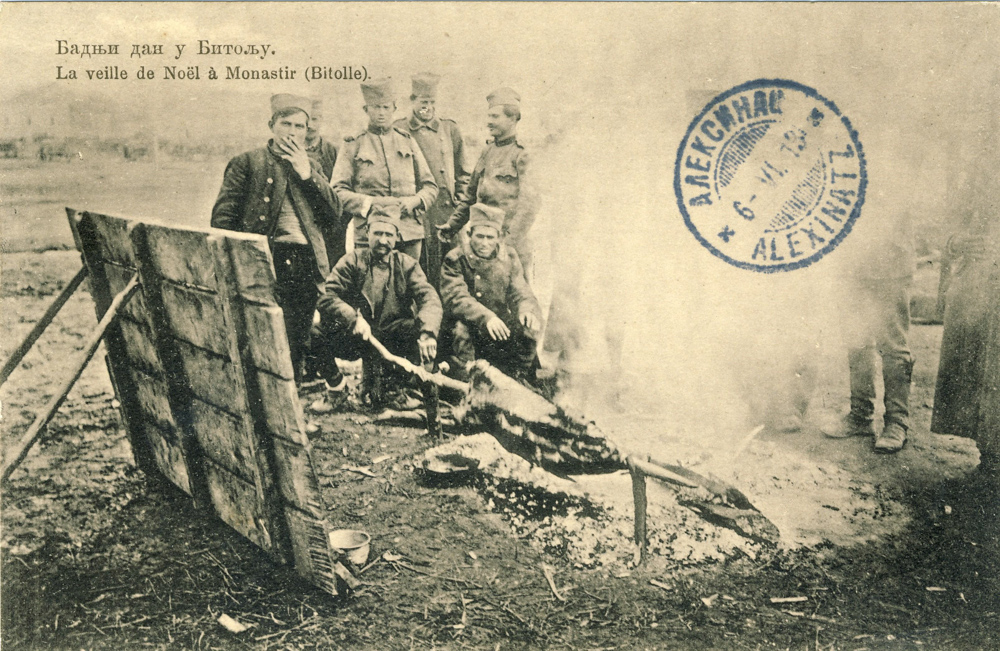
Serbian soldiers celebrate Christmas Eve (January 6th 1913) in Bitola during the First Balkan War
Serbian soldiers celebrate Christmas Eve in Bitola during the First Balkan War

Serbian soldiers celebrate Christmas Eve (January 6th 1913) in Bitola during the First Balkan War
Serbian soldiers celebrate Christmas Eve in Bitola during the First Balkan War

Bitola during the First Bakan War - Location Dragor River - Headquarters of the previous Turkish and new Serbian authorities after the Battle of Bitola (Battle of Monastir) - 16 to 19 November 1912. On the right is Isak Mosque which still exists today.
Bitola during the First Bakan War - Location Dragor River - Headquarters of the previous Turkish and new Serbian authorities after the Battle of Bitola (Battle of Monastir) - 16 to 19 November 1912.
On the right is Isak Mosque which still exists today.

Headquarters of military and the municipality authorities - Location Dragor River - Bitola during the First Bakan War

Picnic at the location Kriva Vodenica in Bitola during the Balkan Wars - Serbian postcard

Picnic at the location "Kriva Vodenica" in Bitola during the Balkan Wars - Serbian postcard

Bitola - Gathering at the church Holy Sunday (Св. Недела) during Easter - Serbian postcard - Balkan Wars

Monastery Holy Sunday (Св. Недела) in Bitola - Serbian postcard issued during the Balkan Wars 1912-1913

Dragor River - Bitola - Serbian postcard issued during the Balkan Wars 1912-1913

Market day in Bitola - Serbian postcard issued during the Balkan Wars 1912-1913

Panorama of Bitola -  Serbian postcard issued during the Balkan Wars 1912-1913
Panorama of Bitola -  Serbian postcard issued during the Balkan Wars 1912-1913

Sirok Sokak (Wide Street) - the main street in Bitola - Serbian postcard issued during the Balkan Wars 1912-1913

Serbian military orchestra passes under the Triumphal Arch during the Christmas holidays in 1913. The Triumphal Arch was built in 1911 (during Turkish rule) on the occasion for the visit of Sultan Mehmed Reshad V of Bitola

Church of St. Simeon, transformed in mosque during Turkish rule of Bitola - Serbian postcard issued during the Balkan Wars 1912-1913

Bitola. First regruts are taking oath. General Gojkovic welcomes them. Location - in front of the Ottoman Military high school (during Turkish rule), today building of Bitola museum. - Serbian postcard - Bitola during the Balkan Wars

Serbian army unit near Bitola - During the Balkan Wars

Street in Bitola during the Balkan Wars

Captured Albanian soldiers (Arnauti) affter the Battle of Bitola (Battle of Monastir) - 16 to 19 November 1912 - Serbian postcard

Serbian canon damaged by Turkish grenade during the Battle of Bitola (Battle of Monastir) - 16 to 19 November 1912 - Serbian postcard

Serbian soldiers celebrate Christmas Eve (January 6th 1913) in Bitola during the First Balkan War
Serbian soldiers celebrate Christmas Eve in Bitola during the First Balkan War

Read more...

Balkan Wars 1912-13 - Photo Gallery - Part 2

The Balkan wars took place in Southeast Europe in 1912 and 1913. The First Balkan War began on October 8, 1912, when Bulgaria, Greece, Montenegro and Serbia formed a Balkan alliance against the Ottoman Empire. The war ended with the signing of a peace treaty in London.
The Second Balkan War broke out on June 16, 1913 when Bulgaria, dissatisfied with its gains, attacked its former allies, Serbia and Greece. The war ended with the signing of a peace treaty in Bucharest.

The postcards shown in this post are from different sources and are not arranged in a specific order.

Serbian officers and soldiers celebrate Christmas Eve (January 6th 1913) in Bitola - First Balkan War
Serbian officers and soldiers celebrate Christmas Eve in Bitola - First Balkan War


Turkish lieutenant colonel Fuad Bey captured in Kumanovo ( Battle of Kumanovo 23–24 October 1912)
Turkish lieutenant colonel Fuad Bey captured in Kumanovo ( Battle of Kumanovo 23–24 October 1912)


Serbian soldiers during rest hours in Edirne (First Balkan War)


Spring in Staro Nagoricane - Before Battle of Kumanovo 23–24 October 1912 (First Balkan War)


First Balkan War - Serbian artillery during an offensive near Bitola


Serbian postcard - First Balkan War


Serbian postcard from the First Balkan War - Depicted are the cities - Krushevac (top left), Skopje (top center), Bitola (right), Prizren (bottom center), Veles (left), Preparation of Serbian artillery for the Battle of Kumanovo (center)


Postcard from the series "Balkan Alliance", „У слози је спас“" (“In consent lies the redemption”) issued during the First Balkan War. On the postcard: Petar I Karadjordjevic, King of Serbia (11.07.1844 - 16.08.1921)
Postcard from the series "Balkan Alliance", „У слози је спас“" (“In consent lies the redemption”) issued during the First Balkan War.
On the postcard:
Petar I Karadjordjevic, King of Serbia (11.07.1844 - 16.08.1921)


Postcard from the serie "Balkan Alliance", „У слози је спас“" (“In consent lies the redemption”) issued during the First Balkan War. On the postcard: Ferdinand I, King of Bulgaria (26.02.1861 - 09.10.1948) Petar I Karadjordjevic, King of Serbia (11.07.1844 - 16.08.1921) Nikola I Petrovic, King of Montenegro (19.10.1840 – 02.03.1921) George I, King of Greece (12.24.1845 - 03.18.1913)
Postcard from the serie "Balkan Alliance", „У слози је спас“" (“In consent lies the redemption”) issued during the First Balkan War.
On the postcard:
Ferdinand I, King of Bulgaria (26.02.1861 - 09.10.1948)
Petar I Karadjordjevic, King of Serbia (11.07.1844 - 16.08.1921)
Nikola I Petrovic, King of Montenegro (19.10.1840 – 02.03.1921)
George I, King of Greece (12.24.1845 - 03.18.1913)


Postcard - Balkan - Turkish War 1912-13 - Signatories of the Treaty of London (Signed on 30 May during the London Conference of 1912–13)  - Skuludis, Novakovic, Strajt, Nikolic, Venicelos, Vojnovic, Genadios, Danev, Madzarov, Popovic, Paprikov, Mijushkovic
Postcard - Balkan - Turkish War 1912-13 - Signatories of the Treaty of London (Signed on 30 May during the London Conference of 1912–13)  - Skuludis, Novakovic, Strajt, Nikolic, Venicelos, Vojnovic, Genadios, Danev, Madzarov, Popovic, Paprikov, Mijushkovic


Postcard - Balkan - Turkish War 1912-13 - Delegates signatories of the Treaty of London (Signed on 30 May during the London Conference of 1912–13)  as guests their London hosts
Postcard - Balkan - Turkish War 1912-13 - Delegates signatories of the Treaty of London (Signed on 30 May during the London Conference of 1912–13)  as guests their London hosts


Postcard from the serie "Balkan Alliance", „У слози је спас“" (“In consent lies the redemption”) issued during the First Balkan War. On the postcard: George I, King of Greece (12.24.1845 - 03.18.1913)
Postcard from the serie "Balkan Alliance", „У слози је спас“" (“In consent lies the redemption”) issued during the First Balkan War.
On the postcard:
George I, King of Greece (12.24.1845 - 03.18.1913)


Serbian postcard - Captured Turkish soldiers in Bitola - First Balkan War


Memories of the Balkan War (Serbian postcard - First Balkan war)


Charge of the Serbian army on Bulgarian positions at Krivolak, Macedonia - Second Balkan war
Charge of the Serbian army on Bulgarian positions at Krivolak, Macedonia - Serbian postcard - Second Balkan War


After the Battle of Kumanovo - Serbian postcard - First Balkan War


Serbian army enters Bitola 18.11.1912 -  First Balkan War
Serbian army enters Bitola 18.11.1912 -  First Balkan War


Departure of the Serbian army from Kratovo to Crn Vrv (Black Peak) - First Balkan War


Dismantling unexploded Turkish grenades by the Serbian army at Edirne - First Balkan War


Camp of the Serbian army near Kumanovo - Battle of Kumanovo 23–24 October 1912 (First Balkan War)


Turkish artillery unit at village Rashtani after the Battle of Bitola (Battle of Monastir - 16 to 19 November 1912) - First Balkan War - Serbian postcard


Milosh Aleksic, lance sergeant of 2nd infantry regiment with his 6 friends - which have captured Lieutenant Colonel Ivan Manev, which in turn contributed to capture 1400 Bulgarian soldiers 19/6 1913
Milosh Aleksic, lance sergeant of 2nd infantry regiment with his 6 friends - which have captured Lieutenant Colonel Ivan Manev, which in turn contributed to capture 1400 Bulgarian soldiers 19/6 1913


Impact of Turkish 15 cm grenade - Killed Serbian soldiers after the fall of Edirne (First Balkan War)


Serbian postcard - retreat of the defeated Turkish army under Zeki Pasha, after the Battle of Kumanovo 23–24 October 1912 (First Balkan War) (11-X-1912 - Julian calendar)


Serbian artillery in Tetovo observes the captured positions - First Balkan War


Serbian postcard - First Balkan War - At the Bitola battlefield  Battle of Bitola (Battle of Monastir) - 16 to 19 November 1912 (5 November 1912 Julian calendar)
Serbian postcard - First Balkan War - At the Bitola battlefield
Battle of Bitola (Battle of Monastir) - 16 to 19 November 1912 (5 November 1912 Julian calendar)


Serbian postcard - First Balkan War - Serbian infantry at the Bitola (Monastir) battlefield  Battle of Bitola (Battle of Monastir) - 16 to 19 November 1912
Serbian postcard - First Balkan War - Serbian infantry at the Bitola (Monastir) battlefield
Battle of Bitola (Battle of Monastir) - 16 to 19 November 1912


Serbian army enters Bitola 18.11.1912 -  First Balkan War
Serbian army enters Bitola 18.11.1912 -  First Balkan War


Russian volunteers in Bitola - Serbian postcard - First Balkan War

Defeat of the Turkish army in Bitola. Animated postcard issued in Prague, Czech Republic in which in a romantic enthusiasm is shown the victory of the Serbian army during the First Balkan War

Charge of the Serbian army in Bitola. Animated postcard issued in Prague, Czech Republic in which in a romantic enthusiasm is shown the victory of the Serbian over the Turkish army during the First Balkan War

Read more...